Even though I’ve still got enough going on in the workshop, it’s time to start planning ahead for the coming winter. So far we’ve done a new project with our building team every two years, and the team’s fingers are starting to itch to get into something new. Richie was going through some books with oldtimer gliders and found the Czech VT-16 Orlik. The original Orlik had it’s first flight in 1959 an was all wood, but filled with foam. It’s got a very characteristic shape and there are not many RC models of it around, and certainly none in a “modernised” version with a thinner airfoil. It didn’t take much for the rest of the team to enamour itself with the plane and decide that we want to build this one.
Fortunately there are many relatively good plans available for this plane on the web. I’ve had the best ones enlarged to our usual 1:3.5 scale. The fuselage is huge, 2.13 meters long. We’ll build the 16m version, which gives a wingspan of 4.6 meters. The length of the fuselage and size of the elevator are great for the model version, and we’ll probably stick to scale (we usually need to enlarge the elevator). We had some discussion on doing the wings in wood/ribs, but decided to build it in our usual method – foam cores, covered with abachi/carbon/glass and carbon spars. We will do the rudder in Balsa/ply, covered with tissue, to save weight and give it at least this little “scale” detail. As usual we will also omit the airbrakes and do four or six control surfaces. Wing profile will probably be MH-32. This will give us a nice all-rounder. We build our planes to fly – a lot.
Richie will now start work on the fuselage plug (which is a huge amount of very messy work – but he likes it and is a true master at this), and Georg will start desiging wing and control surfaces. In Autumn we will probably do the fuselage moulds and start building the wings, in the hope that we can maiden the first Orlik in spring 2022.
Corona-delayed, and a long wait, but she’s there. The Chocofly JS3, fully moulded, 5.14m wingspan, empty weight around 4.2kg. On Monday we picked up three JS for me and two friends in our building team. Ours are the first production builds of the lighter version (production nr. 3, 4 and 5), but wings are still very stiff and their torsional strength is better than our own scratch-built versions.
The Chocofly version is closely based on our scratch-built JS3. Chocofly has used the same wing and control surface profile and layout (all by Georg Staub, who also designed the “small” Diana2 and SB-14). The only difference is that the 5.14m version has “only” three control surfaces, rather than the four in our JS3. The fuselage is stunning, and based on original CAD data. Chocofly has a record number of orders for this plane, and the waiting list is huge. But it’s a beauty and I know it will fly very well – my scratch-built JS3 was my most-flown plane in 2020 and already has clocked up a couple of hours of airtime in 2021.
I’m deeply impressed by the quality of the build. I’ll be building mine with a small retractable JETEC E70, running on 6S. Unfortunately this means that I cannot fly it on our local club airfield (no turbines allowed), but I can fly it at the other club that I’m a member of in Gossau and of course on the slope. I’ve been dreaming of getting a glider with JETEC, and the fuselage is so beautiful that I just cannot bring myself to hack the nose off this one. Haven’t decided yet if I’ll add a landing gear – this will depend on whether there is enough space in the fuselage once the JETEC is installed, and the weight of the plane. Aim is to keep the take-off weight at around 6 kilos at most (my scratch-built one is 6.3kgs, which flies great).
This Moswey III kit is not an easy one. Every time I think that I’ve made a lot of progress on the build I spend hours again on small details. But it’s progressing. Still need to glass parts of the wings and shape the leading edge out of linden/basswood. The work on the fuselage is also almost done, with the canopy, motor mount and towhook fitted. The Moswey III is now almost ready to cover.
Work on the Moswey III continues. With the very short nose, the Moswey III needs around 400-500gr weight in the nose to get the CG right. I’ve tried to reduce this by building the lighter (balsa) version of the elevator (with parts kindly provided by Frank Albrecht, who also produced this kit). Then the difficult decision: FES or not. The opportunity to replace so much dead weight with a much more useful electric motor, and gaining the benefit of being able to fly at my club’s airfield, really makes the answer a no-brainer. Leomotion.com provided a really nice and light electric motor with shaft extension (Dualsky XM4255EA3-12, with DS XM42 shaft extension) and a 14×8 Propeller and a 40mm middle piece. It’s more than enough to bring this bird up. Knowing how the Moswey III flies, it will not be used all that much.
[Edit 7/8/2024: this motor setup proved to be more than sufficient for our Mosweys. Note however that: 1) it was a bit too light for my tail section (the “light” version from Albmodell) and I still needed to add around 40gr weight in the nose, in addition to using 2x3S 3700 batteries all the way at the front of the aircraft (almost touching the motor); 2) the motor is relatively high rev and noisier than the outrunner motors we usually use. So although I’m not dissatisfied with the current motorisation, it would have been possible to install a slightly heavier, lower rev outrunner without it changing the total weight of the aircraft)].
I guess the least favourite work of most aeromodellers is fitting and glueing the canopy. I built the canopy frame a few weeks ago, using plywood, balsa and glass. Sanding it to size and fitting the canopy was a lot of work, but something that just needs to be done. This morning I glued the canopy onto the frame using epoxy resin, doesn’t look too bad. Fingers crossed that it will separate well tomorrow morning.
Also ready are the rudder and tow hook servo setup. They will be glued into the fuselage over the next few days. I’ve gone for very light Chocomotion 12/9.5 servos. They are as powerful as the Futabas that we used for earlier builds. I’ve used these Chocomotion servos before, they’re great.
“Light” is the main theme of this build. Last week we maidened a Moswey III of a colleague in aerotow. It was an older and much heavier version of the kit by Frank Albrecht, with a heavy FES setup. The flight again underlined the importance of building light. The Moswey III handles a bit of extra weight well, in flight. The one of a colleague we maidened last week was well over 7kgs. The problem is that landings can get critical. The stall speed goes up a lot as it’s weight increases, which makes landings so much more challenging. I aim to have my Moswey well under 6kgs. I’ve occasionally flown the very old Moswey III of Georg, which is around 5.5kgs, and a real “balloon”, staying up forever. So far I’m at around 4.1kgs with all electronics, but without covering and some parts of the wings. Curious where it will end up….
With an early onset of spring weather and easing up of the COVID restrictions I’ve been able to maiden my new Towplane, the Eco-Boomster from Hager CNC (see build report in the earlier blog entry below) last week. As I’d seen both the plane and the motor setup “at work”, it was no surprise that the maiden went well. I did two short flights to check all settings (no trim needed, just a bit more down elevator on full flaps, and reducing the full flap throw). It’s incredibly stable, very easy to fly and a breeze to land.
For the third flight my mate Georg offered his 4.8m Ventus 2cx as towcharge, with him as the pilot. I’d only ever done two aerotows as a towpilot before, but all went well. I’ve been doing quite a few tows since, getting used to the plane and especially learning how to tow correctly – which is harder than I expected. But it’s great fun. Yesterday we had a 2nd aerotow day – this’ll definitely become a regular feature as of now.
The motor setup is very powerful – gliders with a weight of up to 15kg are no problem, heavier should be possible as well. I do most tows with half to 2/3 throttle (depending on weight of the plane). But it’s great to have that extra power when needed. Depending on the weight of the towcharge I can do 3-5 tows to 300m with a single 2x6S 7000mAh battery charge.
To my surprise there was another article on the Moswey III, this time in in our local newspaper, the “Zürisee Zeitung”: https://www.zsz.ch/als-in-uznach-segelflugzeuge-gebaut-wurden-879571428937. Unfortunately I cannot reproduce the article here, and it’s hidden by a Paywall, but it’s a nice informative read on the production of the plane in the workshop in Uznach. It also has a nice picture of the restored HB-374.
In the meanwhile the construction of my Moswey III is making progress. The first wing is just about ready to be covered, and I’ve started on wing nr. 2.
In January 1946, Swiss glider pilot Siegbert Maurer attempted to break a glider rekord. On the Albis Pass, across lake Zürich from our club, he started his Moswey III in sub-zero temperatures and with a strong northern wind (Bise). The aim was to stay airborne for more than 28 hours and 7 minutes. Staying airborne in a glider for a long time wasn’t uncommon in this days. Trying to do so in the midst of a cold winter was. Unfortunately he was forced to land after “only” 17 hours, in the early morning of Wednesday 16 January. It wasn’t the performance of his glider that forced him to land, but his fear for serious injury after his legs started showing signs of frostbite.
In June 2016 Frank Albrecht (http://www.albmodellbau.de) provided me with a wonderful cnc-milled kit for the wings and control surfaces of a 4.28m Moswey III. The Moswey III is a glider from the 1940’s that was built in Horgen, which is just across lake Zurich. Frank’s kit is closely based on the first scale model built by colleagues in my club in the 1970s – the first of which, built in 1976 by Georg Staub (chief designer in our building team), still makes its annual appearance in Hahnenmoos (see this low-res video of me throwing it off the Schalmy cliff in Hahnenmoos). The Moswey III is one of the most performant oldtimer gliders I know, and a beautiful plane on top of that.
I’ve been working on and off on the plane for the past few years – using it as an “in between other projects” kit. Three years ago Georg and I produced two more glass fuselages from the original 1970s moulds. In December I picked up work on the kit again where I left off. Frank Albrecht’s kit is beautifully made, and looks very much like the original. But it’s not an easy kit to build, and a lot of work. I’ve set my mind on finishing it this year though, fingers crossed. What helps is that two other colleagues in my club are now having a go at this same kit, including Georg, who’s decided to build an “extra-light” version with FES.
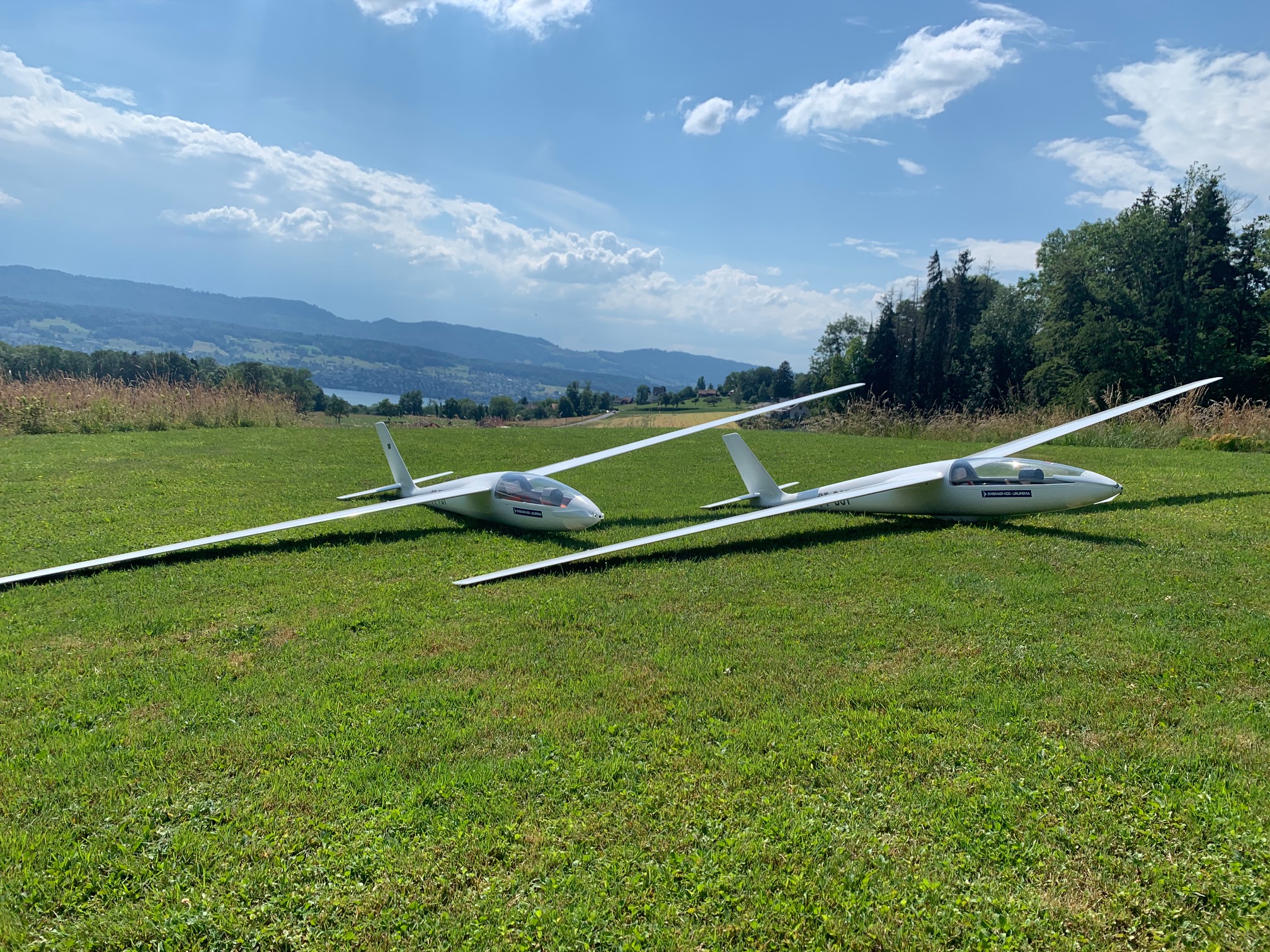
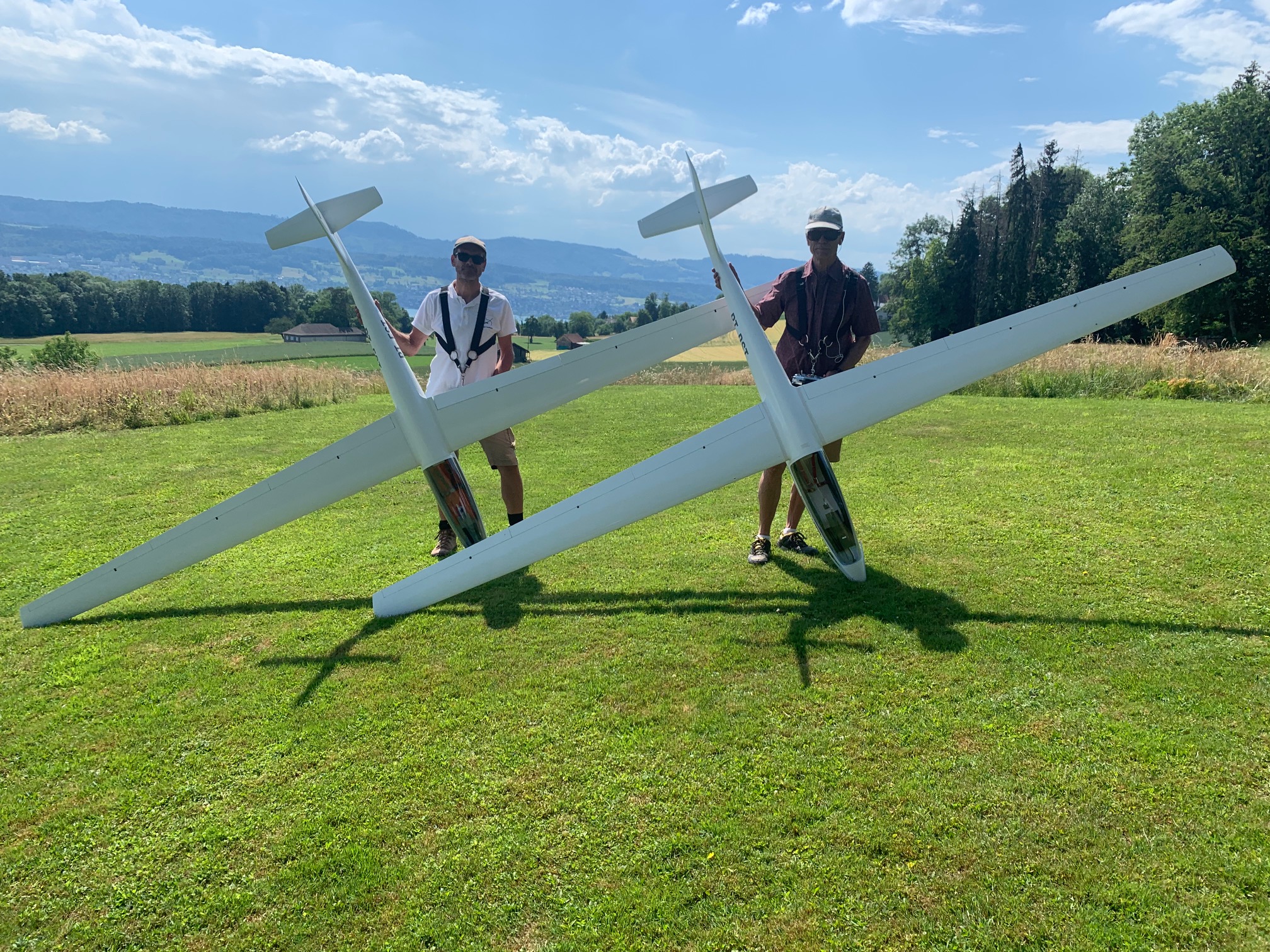
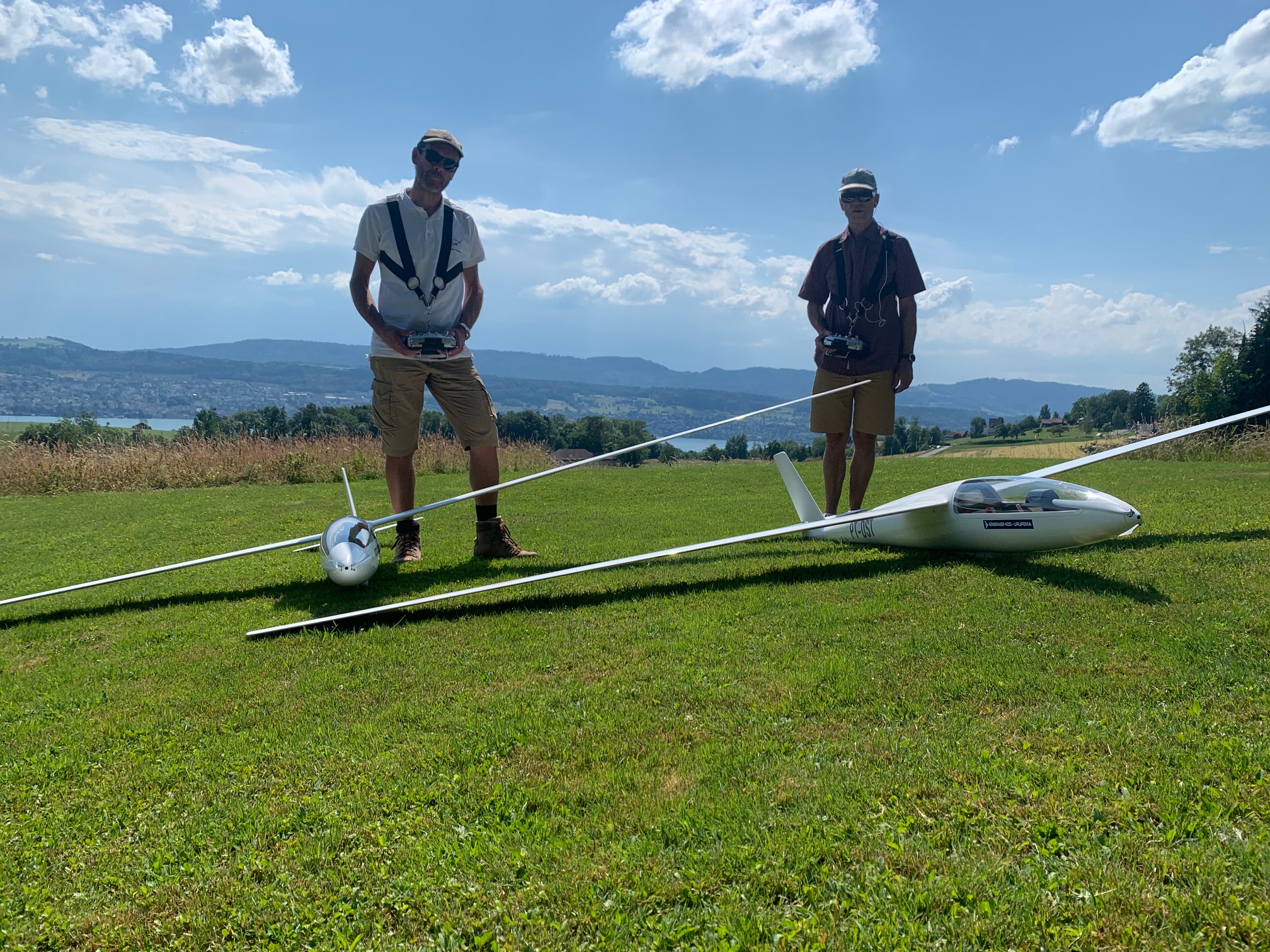
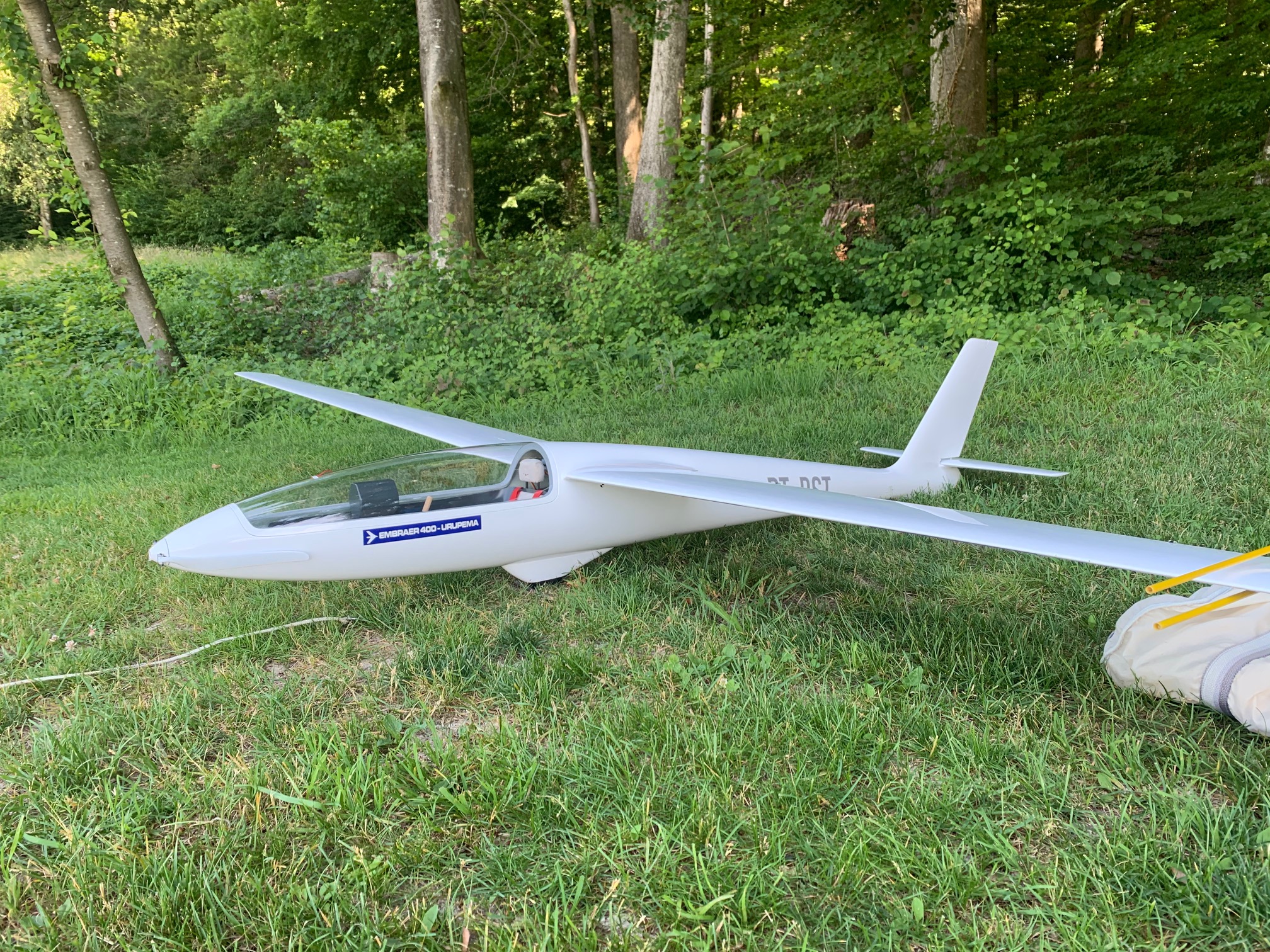
For the first time we got our four Urupema’s together! The regional model aircraft association (Modellflug NOS), organised an exhibition of scale model aircraft in the FLAB Aircraft Museum in nearby Dübendorf. Part of the exhibition had scale aircraft positioned next to their originals (very impressive!). In addition, the exhibition showed the results of the work of model aircraft builders during corona times. We were invited to show our four Urupemas. Quite a sight, and we’re proud of the positive feedback we had from visitors!
We usually maiden our scale gliders in aerotow – we’ve found this to be the safest option. The availability of a tow plane has in the past however often been an issue. I’ve been considering building or buying one for a while already. Having seen the Eco-Boomster of a colleague in action in September, I decided to build one of these as well. The kit was ordered and delivered at the end of September.
Initially sold by the Himmlische Hoellein, the Eco-Boomster can now only be bought directly from the producer, Hager CNC. It’s by far the best kit I’ve built so far. It’s CNC milled, not lasered, and all parts are a perfect fit. It comes with plans and a booklet with very good building instructions (in German). The kit also comes with virtually all small parts and a well-made carbon landing gear. The design is also very well thought through, and should make a very reliable and robust tow plane. Impressive.
The electronics for the Eco-Boomster were provided by Leomotion, as usual. I’ve gone for a pretty powerful setup, with 12S (I’ll measure Ampere and Watts once I get the batteries). The motor is a Dualsky/Leomotion GA6000.9, with a Castle 160A ESC and 24×12 Prop (initially nylon, but to be replaced by a nice wooden one after the maiden flight). All servos are Futaba (3071,3072, 3470 and 9470). The two Futaba 7008 receivers are connected to a Dualsky S.BUS 18 Kanal HUB DUO and the electronics powered by a LiIon RX/TX Battery, 7.2V, 3000mAh. I covered the plane in Oratex – yellow up, red down.
With such a wonderful kit, the building went very fast. The plane is now sitting ready for its maiden flight in my workshop. I’m waiting for the batteries to arrive (2x 6S 7000mAh) and am hoping for suitable weather for a maiden flight in the next few weeks.
Chocofly will be producing “our” JS-3 in a fully moulded version. Wing profile and layout are identical. The fuselage is newly made on the basis of the original CAD data. On Friday Chocofly’s Daniel Aeberli maidened the prototype. This afternoon he did some further tests at our club’s airfield. The prototype has a stiff middle wing that’s based on the “alpine version” specs. The outer wings of the 5.14m version of the prototype are in the GPS light version. The full plane, with JETEC 70 and 5S 5200 battery weighs only 6.3kg.
This plane is simply awesome, even better than our scratch-built versions. The first few production versions will be going to members of our building team, including a very lucky yours truly. I’ll be taking mine in the GPS light version, most probably also with a JETEC70 impeller.
The waiting list for this plane is unfortunately already extremely long, but it’s worth the wait. In the meanwhile, enjoy this “quick and dirty” video of this afternoon’s flights.
We’ve been looking to practise some formation flying with some of our colleagues in our club and have been looking for a suitable plane for a while now. Our two main criteria were; 1) must be scale foamy for less than CHF 200,-; and 2) it must be able to fly relatively slowly. When HobbyKing had its Buffalo Brewster (920mm) on sale, we didn’t wait long and ordered a few. Unfortunately we hadn’t seen the plane fly “live”, but the many videos and reviews on the net gave us the confidence that this couldn’t be too bad a little plane.
We’ve had quite a bit of flying time with these little fellas over the past few weeks. The opinions on this aircraft are very divided, with some hating it and others loving it. One thing is very clear though: out of the box, it doesn’t fly very well at all, but with a bit of work it can be made into a fun plane. After a lot of test flying and fine-tuning, we found that the following changes are essential to get this plane to fly:
Center of Gravity: the internet fora are full of people adding lots of weight to the nose of the plane. Don’t. It flies best with a standard 3S battery (ours are in the 170gr range) pushed forward as much as possible. No extra weight needed.
Elevator Servo: the Servo that comes with the plane has two problems: 1) it’s too imprecise and some have quite a bit of play; and 2) the servo arm is way too long. The Buffalo is very sensitive on the elevator and needs relatively little throw (around 8mm up and down). With the long servo arm and the imprecise servo it flies like a dolphin, impossible to trim it into a straight line. With the Servo Arm shortened and the connector as close as possible to the servo it’s a different plane. If the servo has too much play then I’d also recommend changing the servo (I replaced mine with a metal gear servo).
The motor’s side and down thrust should be adjusted. It pulls too much down and too little to the right. We’ve found that moving one washer from the top left screw to the down right screw (viewed from the front of the plane – see picture below) corrects this. Note that there are differences between individual planes and some may need a bit more, or less, and it’s worth playing around with it a bit.
With these changes, the Buffalo flies surprisingly well and precise. Most of all, it has a huge speed envelope – from slow to superfast. Even then it remains a plane for more skilled pilots. Fortunately it’s incredibly robust though. We hope to start practising some formation flying in the months to come.
Dani Aeberli from Chocofly.com organised the first Diana Flyday on 16 August 2020, in Eglisau, Switzerland. He brought together 27 Dianas, with pilots coming from as far as Geneva, including three scratch-built Diana 1 (4.28m), a whole bunch of Diana 2 (4.28m, both scratch-built and the Chocofly version), as well as the 5m version of the Diana 2 (scratch-built, and Baudis, and a combination of both), and the Chocofly 6m and 7.5m versions. Our building team was represented by Georg Staub (who came with 8 Dianas!), Andi Schwerzmann (4 Dianas) and myself (also 4 Dianas – lined up in the first two pictures below). Our team supplied all the scratch-built planes (the amazing 4.28m Chocofly Diana2 is the commercial version of the one built by members of our team). Georg and I flew our already 14 year old Diana 1, still a fantastic glider, and we also enjoyed some amazing flying of Dani and his 7.5m Diana2. A you’ll have concluded already by my ample use of superlatives: an awesome day, and a big thank you to Dani for organising it. See below for a few pictures. More pictures and videos can be found on the social media channels of chocofly.com.
Over the past few months I’ve sold a few planes that I wasn’t flying enough (Snipe DLG, 2.5m Tomcat, 3.4m DG600 and my 5.14m Chocofly SB-14), so there was some space in my budget and hangar. During our club’s traditional flying week in Hahnenmoos in the third week of June Dani Aeberli from Chocofly sold me a spare Kobuz 3, one of his latest new models, a small one, with 2.18m wingspan. I was very impressed with its performance and since the colour was yellow/black I couldn’t resist – spotting a potential for cool decorations.
The kobuz has been sitting in my workshop since my return from Hahnenmoos at the end of June. As I limit my work on planes to rainy or cold days (the other free days are for flying or cycling), I only managed to complete it last week. Much work went into the “smoked” canopy, an option that’s definitely much cooler than the standard intransparent black cover that comes with the plane (it always annoyed me on my DG600). Chocofly provided the smoked canopy glass, the seat pan, a 3D printed control stick and the printed instrument panel, as well as two 3D printed parts to attach the front and rear of the canopy. Putting the parts together and figuring out a canopy lock that works flawlessly required a bit of time. The canopy set also came with a plotted sticker for the canopy frame. Unfortunately this was in white, a no-go for this plane. Dani however kindly provided the plotting file, which I was able to convert to my Silhouette Cameo so that I could plot a perfect black canopy frame sticker. The result can be seen on the pictures below. Once I had fired up my plotter and unable to resist the great yellow “canvas” of the plane, I also fitted it out with some the symbols and brands of my Flemish/Belgian background. For those unfamiliar with Belgian beer, Rodenbach is a fantastic beer made in my birth town of Roeselare in Flanders, Belgium. The beer is unlike anything else you will have ever tasted, and definitely worth trying (I always keep a crate of it in our cellar).
The epoxy Resin of the battery board hardened out on Saturday morning. And I got lucky with the weather, with great slope conditions forecast for Saturday, so I maidened the Kobuz on Saturday afternoon, on our favourite slope. The first flight was tough. I had just spent almost three hours non-stop airborne with my JS3 (totally awesome), and had a hard time convincing myself to land and having a go at the Kobuz. I’d programmed the Kobuz based on the settings suggested by Dani, the owner of Chocofly. Since I know he loves flying with huge throws, I had already reduced them by a third. But they were still way too big for my taste. The plane also needed quite a bit of left trim. On top of that the lift suddenly stopped after 30mins of excellent conditions and I had to make a quick landing into the slope. That also gave me time to further reduce throws, increase expo and adjust trim. With those changes, the second flight went way better. Soon I was doing 230kmh flybys and having great fun. Unfortunately after 20 minutes the lift again suddenly stopped and another quick landing into the slope cut the flying fun short.
Before leaving to the slope my wonderful wife handed me a few bottles of Rodenbach beer to take along. They provided a very welcome toast with my flying buddies after a great day on the slope and a successful maiden flight.
After two relatively short flights my first impressions: this is a really really cool little plane. I’m amazed at how well it retains speed, even with “only” 2.55kg. It also thermals surprisingly well, although it’s hard to keep it in the air when conditions turn bad (but of course the JS3 is not really a comparison here…). As I had to give quite a bit of up trim with positive camber and down trim with negative camber, I’ll be moving the CG backwards on a next flight. I’ve also increased camber quite a lot over the suggested values (I always program three positive camber settings on the right slider of my transmitter, small, medium and huge), which the Kobuz seems to very comfortable with. This is a plane that I’ll be taking along as a 2nd “in-between” plane on excursions to the slope.
Note: when I bought my Kobuz and wrote this blog post, I wasn’t aware that the smoked canopy was actually a one-off production. Following the success of my Kobuz pictures on social media (and the fact that it really does look very cool), Chocofly has now included this canopy in the list of available options :-). Way to go Dani!
Today my JS3 had another 2.5 hours of flying in light lift on our local slope. It was also the first time that we had three out of our four JS3 (Georg’s, Richie’s and mine) airborne on our slope at the same time. So much fun. The more I fly my JS3, the more I like it. It’s by far the best plane in light thermals in my scale glider collection. Even in light thermals it picks up every bit of lift. It loves tight curves, adding meter after meter of altitude. Stalling behaviour is excellent, even with large camber and lots of up elevator. It just needs rudder for a nice tight curve, and reacts amazingly well to even the tiniest of outer aileron throws. It’s a dream to fly, so easy, it mostly flies itself, and amazingly responsive. As I’ve only flown the 5.14m (18m) version so far I’ve been taking it easy on the fast flyby’s (the wings are very flexible and I don’t want to risk a flutter), but it does seem to like them too. I’m hearing that the prototype of the commercial version, to be produced by Chocofly, is nearing completion – I’ll report on that one as soon as I get some postable material.
Diana 2 Fly-Day…… Sunday 16.August 2020 at
Modellfluggruppe Zürich, Eglisau (https://mgzh.ch/unser-flugplatz/).
Bring your personal Diana 1 or Diana 2 and Fly with us!
Lets see how many we can get together…..World record??
Saturday 15th will be also first time DONs Grill & FLY
Please sign in on the Doodle Link before the end of July 2020…to make sure you can be part of it!
Looking forward to see you all there
Your
ChocoFly Team
Georg has been busy fine-tuning the settings of his Urupema in Aerotow. The CG has been moved back quite a bit, and he has reduced the decalage back to around 0.8 degrees. The result is a much gentler plane, with excellent stalling behaviour, and an even wider speed envelope.
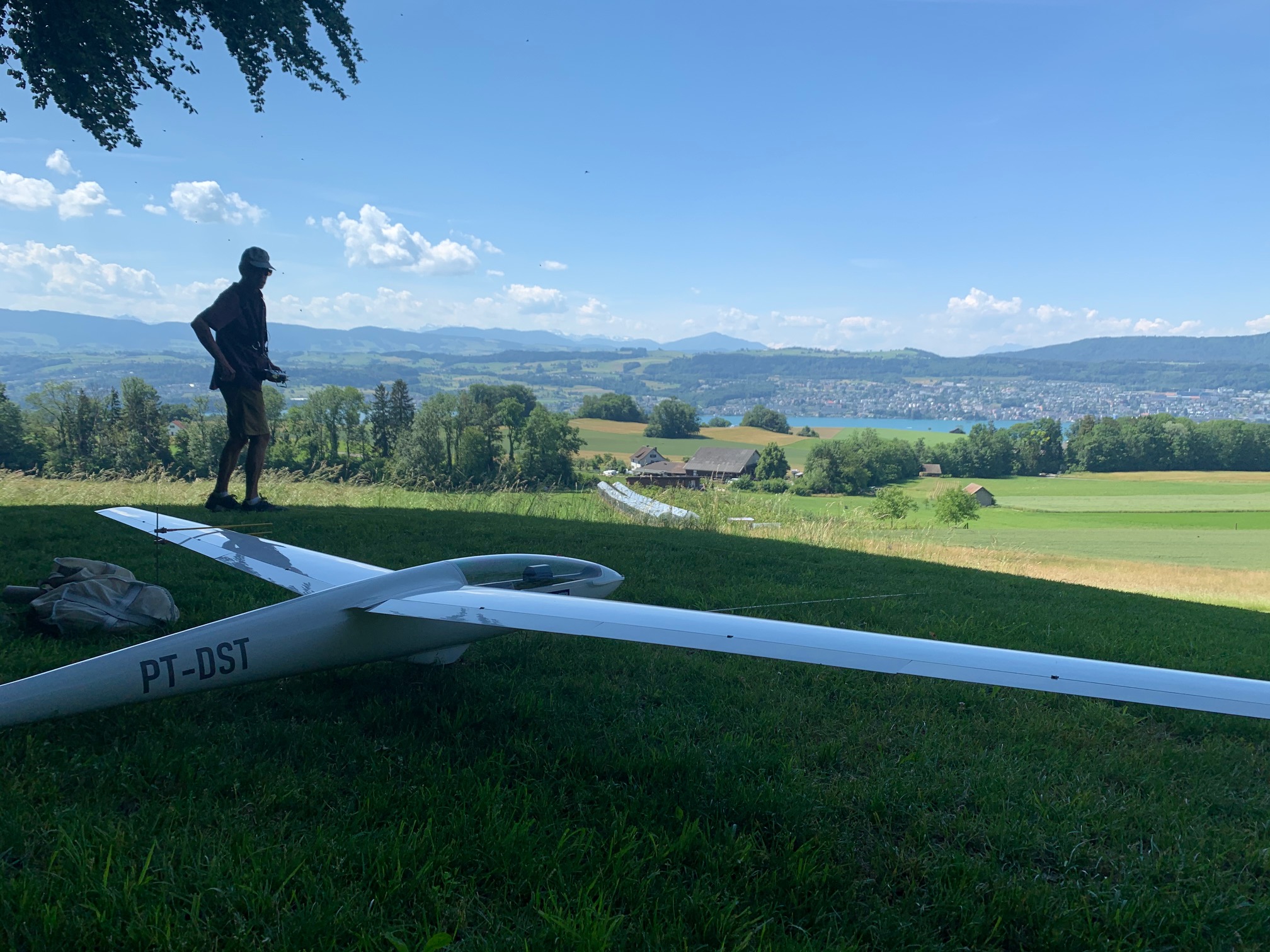
Last week Wednesday I got the first chance to fly my Urupema on one of our local slopes. Before heading out I applied the new settings to my plane. Wow, what a difference. Georg and I spent four hours non-stop airborne with our Urupemas. Even in light lift, the plane was a pleasure to fly. During the flight I swapped transmitters with my mate Richie, who was flying his JS3, just to see the difference between the planes and let him have a first taste of the Urupema (he’s about to finish his, nr. 4). They are definitely two very different planes, both much fun to fly. Of course the Urupema is not a thermalling junky like the JS3 (which just refuses to come down), but the Urupema still flies incredibly well even in light lift. After Richie landed his JS3 I handed him the controls to my Urupema again and asked him and Georg to do some formation flying, so I could do some filming (Richie is a much better pilot and I’m a much better cameraman :-). The result is below. Enjoy.
Today I maidened my Urupema on our club’s airfield, using the club’s catapult. I usually prefer to maiden planes in aerotow, much lower risk, but as thanks to Corona this is currently not possible. It was either catapult or wait. Since I plan to spend a week in Soaring Dreamland Hahnenmoos in a bit over a week, waiting was not an option.
The start went well, but the conditions were terribly turbulent, with massive downwinds and rare but strong upwinds. The landing was adventureous, with a terrible down and tailwind, and too much downrudder mixed into the crow programming, causing the plane to come in very fast on our small airstrip. Fortunately all went well, and the second flight went much better already, and Georg and I even managed to do some formation flying.
We’re still finetuning the settings on this lady, but she’s special. The speed envelope is amazing. You can circle in thermals at close to 40kmh, but she very quickly picks up speed. Without pushing it, Georg already had well over 260kmh. She needs a lot of rudder when circling in thermals, and really likes leaning into the curve. And it’s very hard to stall her, when circling in thermals you can pull the elevator like crazy. I’m only just getting to know her, but this is one special amazing plane. Happy.
This has been an amazing spring of contrasts. While Switzerland has been in a “soft” lock-down, we’ve been enjoying perfect weather and, most importantly, a highly unusual amount of so-called “Bise” days. Normally the prevailing wind is West. But the last few weeks we’ve mostly seen Northerly winds, the “Bise”. This means that it’s impossible to fly on our airfield (which was closed for a few weeks anyway), but also means time for slope soaring. I’ve spent many hours flying on our favourite slopes so far this spring. Pure bliss, although coming down from the mountain back into Corona reality was sometimes something of a shock. Below are some pictures, as well as a video that I did of the first slope testing of Georg’s Urupema. I’m still waiting for a normal westerly wind so I can maiden mine on our airfield – maybe the end of the coming week….



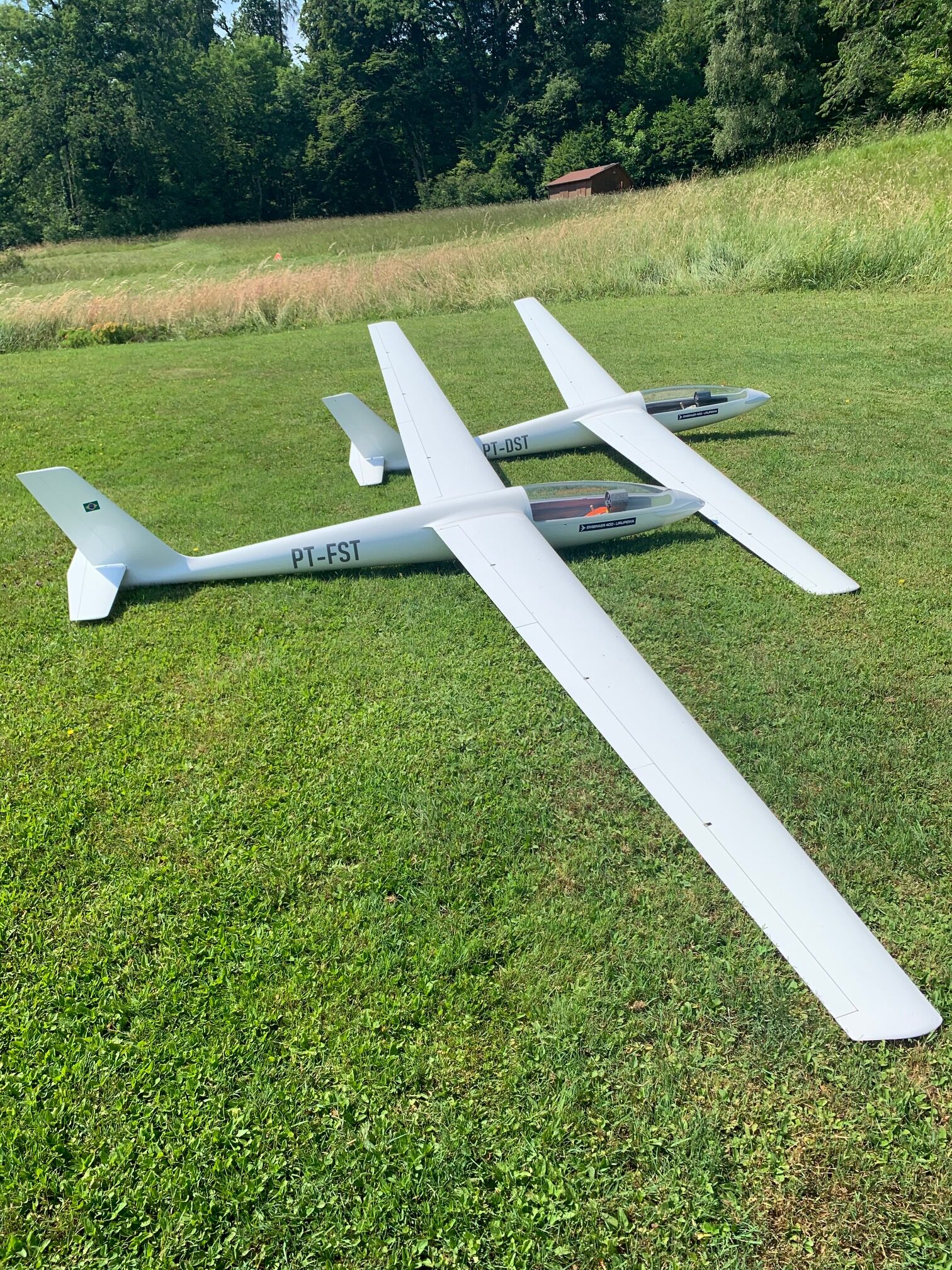
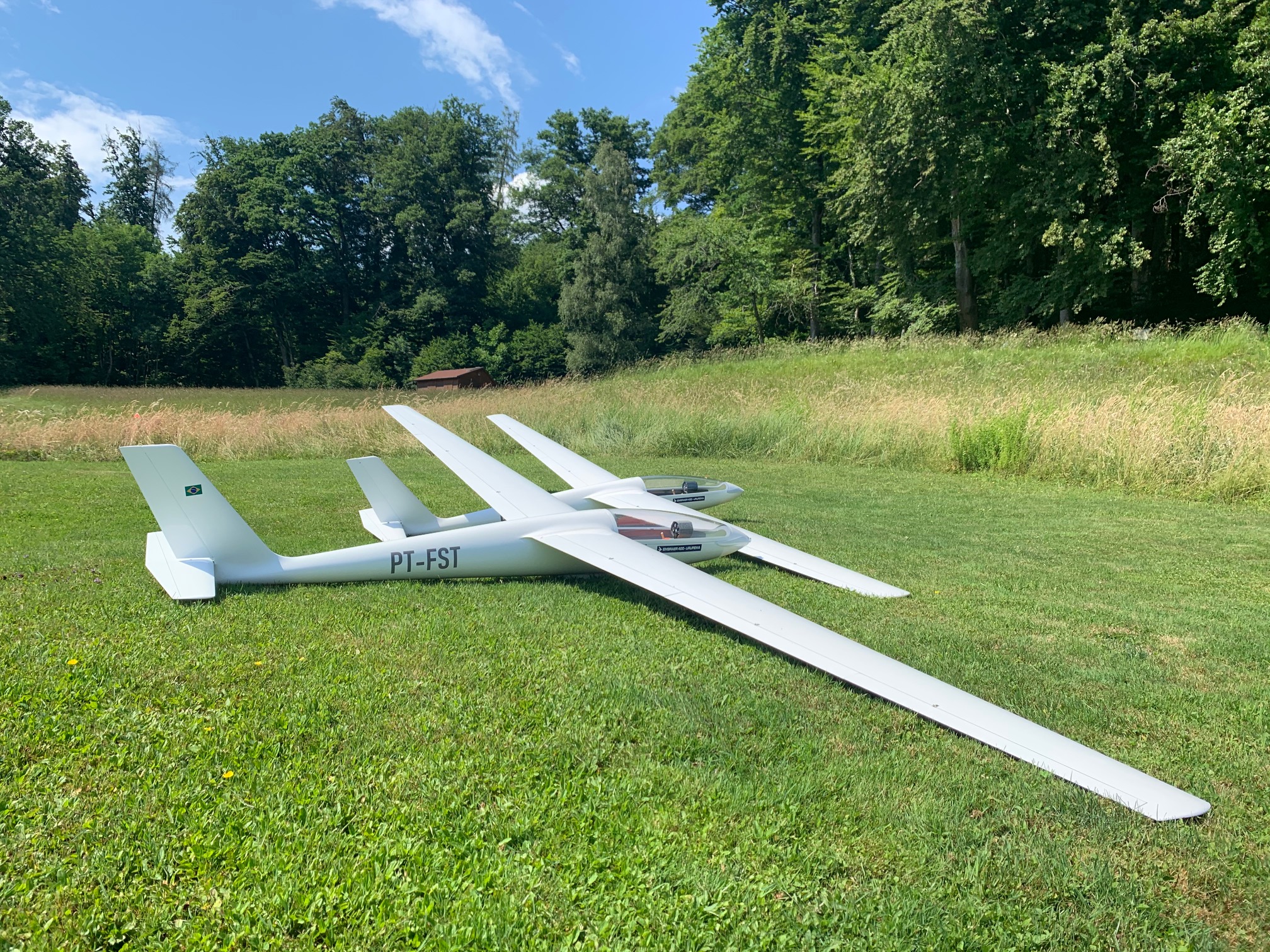
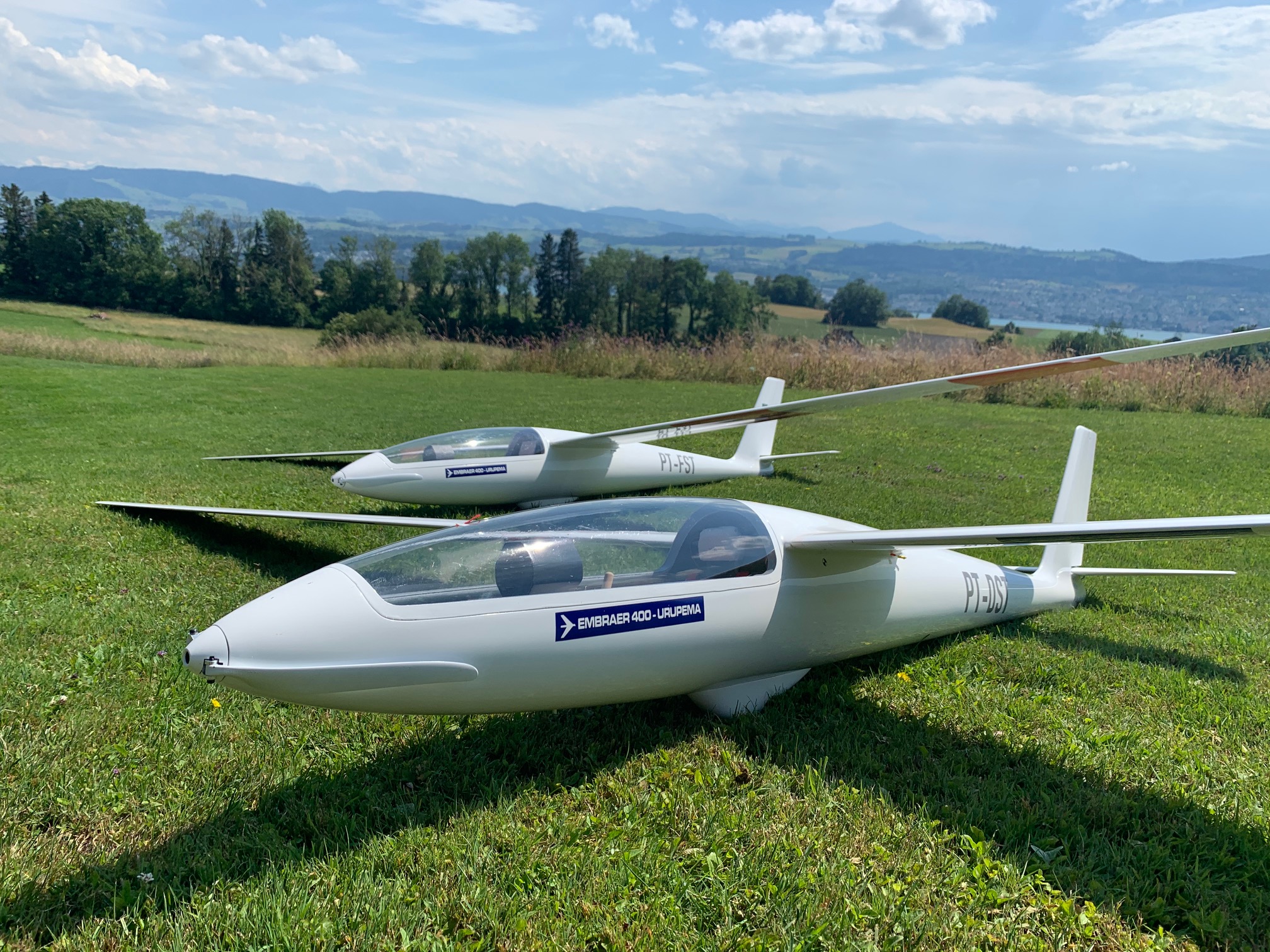


You must be logged in to post a comment.