Georg, as usual, is the first one to have his Elfe built. On Tuesday we had the maiden flight, in excellent spring weather. Also as usual, we did this in aerotow, with Andi towing. The maiden flight went very well, although landings were tricky – the crow/butterfly settings still need adjusting – the Elfe appears to be quite sensitive on this.
The first impression is that the Elfe is a perfect mix between two of my favourite planes: the JS3 and the Moswey III. It picks up thermals very well and likes tight turns, with very easy handling. Georg will be fine-tuning the center of gravity and the throws over the next few weeks, after which it should fly even better. My elfe will probably only be finished next spring – I will close the 2nd wing and then focus on finishing my Diana 4, which is back from the paintshop. More on that – as well as a video of the maiden flights – later.
After an incredibly busy few weeks, also including some great flying weather, today I finally had time to close the first of my Elfe S3 wings, with the help of my flying buddy E.P. It’s resting in vacuum now
Preparing the upper side of the wings is done very quickly. The next step is much more work: preparing the inside of the wings for closing. This requires cutting out the foam for all the inserts as well as preparing the rohacell, carbon sleeves and plywood bits. More details on that later, just some pictures for now. The wings are now ready to be closed.
While we still Georg’s workshop set up for building fuselages I got the opportunity to also build the fuselage for my Diana 2 (1:3). Andi again kindly spray painted the mould and Georg and I built the fuselage. Although the glider is bigger than the Elfe S3, the fuselage is much thinner and the work was thus about the same as making the S3 fuselage. Glass layup was: 1) 160gr; 2) 280gr (diagonally); 3) 280gr (normal) at the front and 160gr at the tail. We added 2x UD band under the cockpit and some reinforcements in the tail area. The fuselage came out nicely, although a few more airpockets than we got on the Elfe S3 (not uncommon when you know a mould less well).
The vacuum pump is running in my workshop on wing nr. 2 (upper side), so some time to sit behind the computer and look at the decals and logos.
We will be using HB-935 and upwards for our Elfes. The decals are pretty standard: the registration number, a Swiss cross as well as the initials of the pilot/builder. We also decided to add a nice Elfe S3 logo under the canopy. There are various versions in pictures online, see some examples below. I used these to draw our own logo.
Make sure you clean the wing cores from any “angel hairs” resulting from the cutting (using a vacuum cleaner with brush).
Prepare the negative “covers” with packaging tape that doesn’t stick to epoxy resin (try out different brown tapes – we’ve found that the one sold at the Landi in Switzerland works very well – and is very cheap).
Prepare building board, so that you can tape the negative of the underside of the wing into the right position onto the building board.
Tape the negative of the underside of the wing into the right position on the building board and also prepare it with brown packaging tape.
Prepare the ebechi (abachi) wood (0.8mm) by lightly sanding it nice and smooth and paint it with nitro base primer (nitro hartgrund) to ensure that the ebechi doesn’t absorb too much of the epoxy resin.
Prepare the carbon fabric (we prefer to use biax ±45° 100g/m² from Suter – it’s got great torsional stiffness and is very easy to work with). For the upper side I use carbon for the entire wing area. Georg likes to only use it in the area of the D-box, the control surfaces, the wing joiner and where the servos are glued in). I’ve found that the weight penalty of doing the entire wing in carbon is minimal (20-30gr per wing) and it gives the upper side of the wing a much nicer shape, with less deformations.
Once all that is done prepare the epoxy resin (I used around 100gr in total of epoxy and hardener). Using a soft roller, first apply some to the ebechi. Then put the carbon fabric onto it and roll to “pull up” the epoxy. Add more epoxy resin as necessary. You can use a hard roller and some kitchen paper to remove excess epoxy (I “removed” around 6gr on the entire wing – very minimal).
Assemble all the bits of the wing into the negative, making sure the wing cores are in the right position, cover with the negative “covers”, making sure you fix key bits with a bit of painters tape.
Then put the whole building board into the vacuum bag. Start the vacuum pump and leave it running for 10-12 hours at -150mbar. I use a webcam and a timer so that I can check the pressure from time to time (although my vacuum pump has no trouble keeping this up).
On Thursday Georg and I built Fuselage nr. 4 of our Elfe S3. Today we took it out of the mould.
Andi had again spray painted the mould very nicely. Building went a bit faster than last time (we usually need between 5 and 6 hrs with two persons). The upper side of the fuselage looks great. The underside has more airpockets at the rear, we probably didn’t press it enough with the small rollers after closing the mould. It’s not a big problem to fix though, as the fuselage will be painted afterwards anyway. The weight is just over 1.5 kgs – also within the usual range.
While I’ve been focussing on getting my Diana 4 ready for the paint shop, the other members of the building team have made significant progress with their Elfe S3. Georg’s Elfe is already back from the paint shop, and the ones built by Richi and Andi are not far behind.
Time for me to put myself behind the computer and design the instrument panel for the Elfe S3. Here we are both lucky and unlucky. Unlucky in the sense that we’ve not been able to get good pictures of the cockpit interior of the Elfe S3. Lucky in the sense that the Elfe S3 was built in so many versions and changed so much over time that we can really do what we want with the instrument panel.
I’ve used the picture of the instrument panel of the HB-902 an an example to construct the panel below. The PDF file linked through below is to size for our fuselages. The HB-935 immatriculation is the one to be used by Georg for his Elfe S3.
My Diana 4 is finally ready to be spray painted. I’ve been struggling to get the fuselage done over the past few months – somehow my fuselage had more airpockets in it than I’ve had with earlier self-built fuselages. In addition, the wing root needed significant adjusting (the fuselage is originally that of the JS3, which has deeper wing root). I’ve used many coats of primer, followed by wet sanding and yet another coat of primer to get it into a shape where I feel happy sending it off to be spray painted.
Before making the final preparations for spray painting I also drilled the holes for the winglets (which are Chocofly winglets for their Diana 2 1:3.5). This was a relatively easy job using the nifty tool prepared by Georg (see picture).
To give both fuselage and wings (upper side only) a better finish before the spray painting I’ve used a new primer (ColorMatic 1k Primer Filler – white). This appears to be even better than the one I used before (duplicolor Spritzspachtel/acrylic spray putty). The ColorMatic is a bit harder than the Duplicolor and yet easy to sand. Importantly, it’s also available in white. I do hope it doesn’t react with the PU paint. Very curious to see how it comes back from the paint shop. Fingers crossed.
I’ve had several questions in the past on how we prepare our fuselage moulds, and in particular what products we use to make sure the fuselages separate from the mould. Here’s a short overview of how we do it and what products we use:
1) Clean the moulds using a mould cleaner. We use the R&G mould cleaner on the picture below, but that seems to be no longer available. Apply it with a paintbrush, give it some time to rest and then wipe the mould clean with a clean cloth. Then wash the mould with Acetone.
3) Apply a coat of PVA film release agent. We use the SCS PVA Folientrennmittel. Make sure you apply it with a water-soaked fine sponge. We use the blue SCS PVA sponge.
After this the mould is ready to be spray painted. We’ve never had any issues with the fuselages not releasing from the mould using the procedure above.
The Diana gliders will always remain one of my favourites. I’m lucky to have a number of Diana gliders already in my fleet: a Diana 1 (1:3.5) that was built by my mate Richi and that I added to my fleet in 2018 (the plane is from 2004 and still looks like new and flies great), my scratch-built Diana 2 (1:3.5)(my first ever scratch built glider), my Chocofly Diana 2 (1:3.5)(with both a FES and a light glider fuselage), as well as my Baudis Diana 2 (1:3). And of course there’s my new Diana 4, work on which is ongoing.
Although I really like my Baudis Diana 2, the plane’s fuselage suffers from serious anorexia. Unfortunately Baudis reduced the fuselage contours from the original. It might be faster, but it just doesn’t look very nice. Luck has it that Richi and Georg produced a Diana 2 in scale 1:3 already over 20 years ago and have kindly allowed me to use their moulds and plans. They equipped their Diana 2 with a somewhat thicker airfoil than the (much) newer Baudis and left the fuselage size to original scale. I’ve seen their Diana 2 in action on many occasions – it’s a beauty with a very impressive performance. While not as fast and dynamic as my Baudis Diana 2, it is definitely a better thermaller.
Building one for myself has long been on my wishlist. My mate Georg kindly agreed to help me build a fuselage from the mould this winter. Although I will have enough work for the next year or so at least, finishing my Diana 4 and the new Elfe S3, I do like having multiple projects running in parallel.
The picture below shows my Baudis Diana 2 (1:3) and Georg’s self-built Diana 2 (1:3) fuselage, equipped with Baudis wings and tailplane (the plane up front with initials GS). Unfortunately the picture doesn’t do as much justice to the nicer fuselage – it looks better in real life.
The first fuselage of the Neukom Elfe S3 is out of the mould and it looks great. We spent almost six hours building up the fuselage in the mould – longer than expected. This because it’s the first time we are building in this mould and we were still “getting to know it”. An additional challenge was that we decided to use up an old stock of “atlas” glass cloth – which has a finer weave and is lighter, but was more difficult to place into the mould (and kept on making little “waves”). Plus we used our new epoxy resin, which only has 50 minutes before it starts curing and becomes too thick (i.e. we had to use multiple small portions but were still faced with tools that got stroppy and lower layers of glass where the epoxy was curing faster than we would have wanted). Considering all these challenges, we were surprised that the fuselage came out so well.
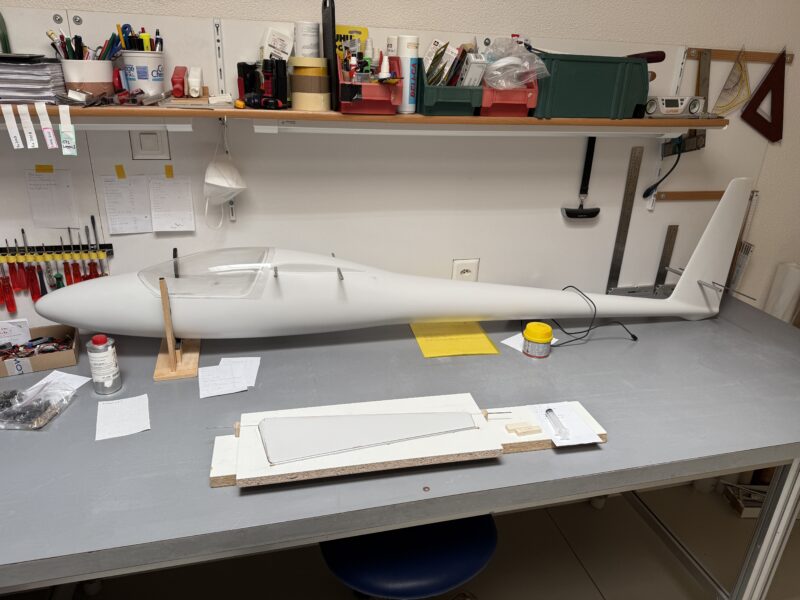
In the excitement of seeing the first fuselage we had to fit the horizontal stabiliser and rudder that Georg has already built, as well as the prototype of the canopy (we are awaiting the rest of them in the next few weeks). We’ve still to weigh the fuselage and check for air pockets.
I’ll give an overview of the glass layup of the fuselage in a next post.
I prepared the four wing joiners four our Elfe S3 last winter already. Now that we have the fuselage sizes I could do the sleeves around the joiner, that will go into the wings. These are made of woven kevlar, with a second string of kevlar wound lightly around it. I first made the wing joiner nice and greasy using bicycle grease (a really thick coat), followed by 1.5 rounds of clingfilm or thing plastic vegetable bag. The kevlar sleeve is epoxied around that. I then apply tear-off tape and hang a weight at the bottom of the sleeve and let it cure. Once cured, repeat that for the other side of the joiner.
I’ve started building the horizontal stabiliser. Although the stabiliser will be in two parts, we built is as one – including most joiners – separating it afterwards.
We cut the foam a few weeks ago and Georg made a great plan for building the stabiliser – as usual (all by hand – see the last picture below). I prepared the carbon and glass layup, to be placed between the foam and ebechi, applied the epoxy and put the first side in a vacuum bag for 11 hours. I then cut out the various openings for the 10×1 carbon tube with glass sleeve (main joiner for the two halves), balsa where the 4mm steel pin joining the two halves will come, as well as small brass tubes with the 2mm steel pin for the elevator control. I also cut out a foam strip, inserted it into a carbon sleeve, which will be where the elevator will separate from the tailplane. Also make sure you remove a bit of foam from the leading edge and add in some thickened epoxy, so that you can sand it into a nice leading edge afterwards. Plus I inserted small bits of plywood at the end of all three pins connecting the two halves to prevent that these pins are pushed through into the foam when building up the plane later on. Then I epoxied the carbon and glass inserts onto the ebechi, closed the stabiliser and again put it into vacuum for 11 hours.
Once fully cured, I carefully separated the two halves of the stabiliser and sanded back the ebechi and the leading edge into shape.
In-between working on the Elfe S3 I’m also still working to get my Diana 4 ready. It has been sitting in my workshop for a while, waiting for me to finish it.
Fitting the canopy frame is always a bit of a pain and I usually leave it to a day where I feel like having a go at it.With a self-built canopy frame and canopy there are no real shortcuts. It’s a job that requires a lot of time and patience.
Essential is that the canopy frame is sanded back so that the canopy nicely fits onto it and is level (or just a bit inwards) from the fuselage. The worst looking canopies are those that stand outside the fuselage.
Once the frame is sufficiently sanded back, it’s time to cut the canopy to size. I usually do a rough large cut and then try it on, marking it with a marker pen and further cutting it back (I have a nice Tamiya canopy scissors that does a great job). Once you more or less have the right shape, it’s time to make the perfect fit. Before you do so, make sure that you mark the center line front and rear of the canopy so that you always put it in the exact same place. I then use a permagrit sanding block (the really coarse one) to slowly sand back the edges of the canopy. And then just try, sand, try, sand, etc…. It usually takes me at least a few hours to get it right. Once you’re satisfied with the fit I use a fine grit sandpaper to smoothen the edges of the canopy.
Before glueing the canopy to the frame I first make sure that the fuselage is nicely waxed so that the canopy doesn’t glue to the fuselage, but just to the frame (epoxy always has a way of “escaping”).
Not it’s time to glue it on. I use normal epoxy resin, coloured grey (same colour as my canopy frame) and thickened using both micro-balloons and aerosil. Using a pencil I apply it evenly around the frame and place the frame on the fuselage. This is probably the hardest part – too much and you have a mess with epoxy coming out when you place the canopy, too little and you have gaps between the frame and the canopy.
I then carefully position the canopy onto the frame. Make sure you remove any excess epoxy – if there’s some on the edge of the canopy then use some alcohol to make sure that the canopy is clean (saves a lot of work when spraying the canopy edges). If you did your job fitting the canopy really well, it fits perfectly and you can just let it cure. I’ve never succeeded in doing that. So I usually end up positioning the canopy with bits of tape or double-sided tape on ebechi. You can also wait for the epoxy to partially cure and then carefully press the canopy onto the frame in places where the canopy stands out. Then let the epoxy fully cure.
I got lucky and the fit turned out very well. I did have to fill a few gaps between the canopy frame and the canopy with some thickened epoxy, just to make sure that the inside edge is perfect.
Once all this is done I carefully sanded the edges of the canopy so that they are nice and smooth. I also lightly sanded the edge of the canopy to be spray painted. Then I carefully covered the bits that are not to be painted (make sure you use good masking tape, not the 3m DIY stuff!) and first applied a bit of primer, followed by a few coats of white. I’m pretty satisfied with the result.
The fuselage mould for the Elfe S3 is done and ready to be spray painted so we can start building the first fuselage.
Here is how we made the fuselage mould:
– Using the right wax in the right places is key. For building the fuselage mould we use: 1) a coat of HP-G1000 priming wax (HP Textiles); followed by 2) three coats of a release agent based on polyvinyl alcohol, dissolved in a mixture of ethanol and water (SCS PVA-folientrennmittel). We’ve used this for building all our recent moulds and never had any issues releasing the plug from the mould..
– Following the fitting of the plug in the parting plane and filling the gaps between the parting plane and plug with blue tac, the separator for the tailfin is mounted, the holders for the centering pins are placed into the parting plane and the edges of the mould are marked by brown packing tape (also marking the part of the parting plane that needs to be waxed). A foam bloc is places in the space for the canopy. Also the various pins for the gaps in the fuselage for attaching the wing and horizontal stabiliser are set and waxed.
– Next we build up one half of the fuselage mould on the plug and parting plane. The layup of our mould is as follows (note that we only make around 4 fuselages out of this mould, so it doesn’t need to be super-robust):
First a coat of special mould resin (we use Formenharz P from Suter/R&G). This needs to cure for a while (1-1.5hrs) before we can start on the next layer;
Put a smal strip of 25-30gr glass on the parting plane, tightly around the plug, followed by thickened epoxy resin, so that the edges of the mould are reinforced and minimising the chance of air pockets;
Build up epoxy resin thickened with cotton flakes around key areas such as the connection to the wing and around the pins for connecting wing and horizontal stabiliser, but also ridges around the canopy;
Apply the glass. Each layer of glass becomes a bit of extra epoxy – enough to fully soak it. The epoxy is evenly distributed using a small roller, which is also used to ensure that no air is trapped underneath the glass. We add the following layers of glass:
2 layers of 165gr glass
1 layer of 280gr glass
1 layer of 280gr glass around the edges of the mould, not on the plug
1 layer of 280gr glass
1 layer of 280gr glass around the edges of the mould, not on the plug
1 layer of 280gr glass
2 layers of 165gr glass
Build up epoxy resin thickened with cotton flakes around the pins for connecting wing and horizontal stabiliser as well as around the holders for the centering pins for the mould;
Apply tear-off fabric to the places on the fuselage mould where the plywood feet are to be added
We let the first half of the mould rest for about a week. After a few days we added the plywood feet (three).
After a week we very carefully removed the parting plane (leaving the plug in the half-mould!) as well as the tailfin separator. We then added a new tailfin separator as well as the holders for the centering pins and foam for the cutout of the canopy.
The 2nd half of the mould is then built up in exactly the same way as the first half – see above.
We then again let the mould rest for about a week, adding plywood feet after a few days.
After this week the edges of the mould are cut off and rounded, after which the mould is carefully separated and the plug removed.
We then sand out any uneven bits from the mould using 600 or 800 grit sandpaper (wet) and then polish the mould progressively using 1000 and 1500 grit sandpaper (wet) followed by polishing/cutting past. After another cleaning, the mould is now ready to be waxed and then painted for the first fuselage.
It’s time to get back to the workshop and start building again. I still need to finish my Diana4, which has been on the back burner while I finished my Monerai. In addition, we are resuming the work on the Neukom Elfe S3.
In the past few weeks, Georg has prepared the parting plane for the fuselage plug. I helped him set up the workshop to prepare building the fuselage moulds and fitting the plug into the parting plane (so that it’s perfectly centered). He will now fill the gap between the plug and parting plane with paste (bostic/blue tac) and wax the plug and parting plane.
We also started cutting the styro foam for the wings and elevators.Over summer Georg built a nifty foam cutting installation. It works really well and ensures an even nicer hot wire cut than the manual cutting we did in the past.
This year’s annual club outing to Hahnenmoos in June was great. We spent many hours flying in excellent weather, especially at my favourite flying spot Luegli. With many flying hours unfortunately also the risks of damage increase – especially landing on alpine slopes. I misjudged the landing of my Chocofly DG800 after a few hours of flying in Luegli and came in too fast on a down-sloping hill. During the landing the plane’s wing caught on a lump of grass, causing the plane to twist in the last few meters of the landing and the tail boom of the DG800 snapped in two. Fortunately it was a clean break and the plane had no significant further damage.
In my collection of cardboard tubes I found one that was approximately the size of the tail boom. I covered this with cling film and then laminated a carbon sleeve around it (covering it with peel ply so that it’s nice and tight and is also easier to laminate into the fuselage). Once the resin was cured I cut the sleeve across so that it perfectly fit the inside of both sides of the tail boom. I then epoxied this sleeve into the plane – taking care that the tail was exactly in the right place. After letting this cure I added a few bits of 50gr glass to close any remaining gaps, together with some resin thickened with micro-balloons and finished it off with a layer of 50gr glass all around the repair. After lots of sanding – primer – sanding I spray painted it with 2 component paint.
On Monday my Monerai had its first flight on our favourite slope in Toggenburg. My mate Richi, who designed and built the first Monerai, as well as built the fuselage mould, took his Monerai as well – the first time we had both of them flying together. We had great lift and my Monerai was up for three hours in a single flight. It’s such a fun little plane to fly on the slope. I was amazed by how fast it picks up speed, even with only 3.7 kg (I easily hit 220kmh on one the quick passes). It allows for very tight turns. I added quite a bit of snap-flap, further increasing its ability to pick up thermals. It also rolls very nicely. Of course it’s nothing like our bigger gliders in terms of course stability and climbing rate in light lift, but that’s obvious from the glider’s design. It’s a lovely small light plane to play with on nice slope days. This one will also join the selection of gliders coming to Hahnenmoos in June.
The plugs for the fuselage and the rudder are ready. Our shaper Richi has done an amazing job, as usual. The part where the wings join the fuselage was particularly challenging, as we will be using a pretty thin airfoil – unlike the original Elfe S3. With the wings sitting at the top of the fuselage Richi had to be creative in shaping that part of the fuselage.
Next step is building the moulds. We will probably only do the fuselage mould in Autumn – unless we are faced with a few weeks of non-stop rain. Georg has however started preparations for the mould of the rudder, which he will build. He will also be making four rudders for the four Elfes that we are planning to build. The wings will be in our usual styro-ebechi with carbon and glass layup building method.
Today we maidened my Monnett Monerai in aerotow. I couldn’t organise a tow-pilot so we decided that I would tow and my mate Georg would fly my Monerai. The first two starts and landings were astonishingly uneventful. No trim or adjustments to any of the settings needed. It flew just perfectly as it was. It does have a sink rate larger than our big wingspan scale 1:3.5 ships – to be expected for an 11m (3.14m) wingspan glider. But it takes thermals surprisingly well – especially with a lot of camber. It’s also absolutely easy to fly and land. A lovely little toy. For the third start we changed the transmitter layout to mode 2 (from mode 4, the preferred setting of Georg) and I took over the Monerai after landing the towplane. I’m totally hooked on this little baby. Unexpectedly, another towplane showed up and gave me two more “rides”. At the last flight I caught some wonderful spring thermals and also tested the Monerai with a barrell roll and a looping. It performs wonderfully in every respect. I look forward to playing with it a bit more on the slope or in aerotown shortly.




You must be logged in to post a comment.