There are quite a few Monerais still out there, including some for sale, but not too many good quality pictures or designs that caught my liking.
To my surprise I found that there are several Monerais that were built and registered in Belgium. Two of these can be found on the website of the Aviation Society of Antwerp – the OO-70 (with pylon motor) and the OO-72. Coincidentally, I’ve traditionally given all my gliders without FES a Belgian registration number. So the decision was very easy to go for the OO-70 registration number for my Monerai. Unfortunaly the picture on the website of the Aviation Society of Antwerp isn’t too clear on the rest of the decals and since the Monerais were often repainted and changed I decided to go for my own design.
As information on the Monerai is starting to disappear from the web (the website containing the plans and building information is no longer online), I post a cleaned up version of the logo of the monerai here.
Cutting out the control surfaces always makes me nervous and I tend to push it off until I feel that I’m really up for it, with a clear mind and a steady hand. So much can go wrong and it can really mess up your build. Fortunately I’ve never messed it up so much that it wasn’t salvagable and the final plane looked crap.
We usually set the hinges of the wings at the bottom and the tailplane at the top of the wing. The reason for this is that the “seal” for the gap on the tailplane is tape (easier), whereas we do set a seal at the upper side of the control surfaces for the wings (more on that later). Most importantly, you want the airbrakes (inner control surfaces) hinged at the bottom to allow maximum throw.
To cut out the control surfaces we use a hand-held milling machine – basically an old Dremel with a brass add-on made ages ago by a club colleague (see picture). This brass add-on allows you to pull the dremel along a ruler or aluminium profile or bar. The aluminium profile is fixed to the wing with bits of double-sided tape. The starting and end-points are defined by the little holes in the surface of the wing that I made before bagging the underside of the wing and are positioned between the two rear spars of the wing (and the holes were kept open during the various stages of building the wings including the spray painting).
For the top of the wing I use a 2mm milling bit, for the underside (where the hinge comes) I use a 1mm milling bit (the reverse for the tailplane). I’ve learned the hard way that it’s worth investing in good quality milling bits that are made for cutting carbon fibers – the cheapo chinese bits don’t last very long. I’ve also built a foot-controlled switch so that I can turn on and switch off my Dremel with my foot and don’t have to use the switch on the Dremel itself. Make sure that you pull the Dremel along the profile from left to right, with the profile at the underside of the Dremel (if it rotates to the right it will pull the Dremel nicely against the aluminium profile and reduces the risk of it “wandering off” and messing up your wing).
After cutting the long horizontal bits I carefully separate the control surfaces using a small saw. Then I clean out the foam, lightly sand all the corners and surfaces that are cleared of foam. The wings then need much more work still, more on that later.
Cutting out the openings for the servos is done in a similar manner. We have small templates that we tape to the wing using double-sided tape and then cut out the openings using the dremel with a 1mm milling bit.
The next step on the tailplane is to check if any bits need protection or correction using a some resin (if necessary coloured white). After that I position the control surfaces using good quality wax tape and 1mm thick pieces of balsa-wood. I then apply silicon glue (Wacker Elastosil E41) using a syringe with a 3/2 mm aluminium tube, wiggle the control surface a couple of times and then fix in place using leftover bits of ebechi wood with double-sided tape. Leave that to cure for 3-4 days and then carefully remove the wax tape (don’t pull out the silicon!) and the tailplane is ready for the servos to be built in.
Over the weekend I’ve been doing some background research into the Neukom Elfe S3 – in particular to find more information for the decals and cockpit for our Elfe. This post summarises the main points that I’ve found, as an effort to bring together key bits of information for further use as we work on our models. Note that Neukom was known for continuously improving/tinkering with his gliders, there are various versions of the S3, the below list also includes the S2/3, bot the x-tail and v-tail versions.
As far as I could find, in total 12 ELFE S3 (including a few S2/3) were registered in Switzerland over the years. Only two of these seems to be registered/flying in Switzerland still. Two were exported to the US and are still registered there. One is in the Transport museum in Lucerne:
HB-902, ELFE S 3 P, Baujahr 1968 Werknummer 18: still registered, stationed in Schmerlat
HB-903, ELFE S 3 P, Baujahr 1968 Werknummer 17: removed from the aircraft registry on 16 August 2012 following serious damage after outlanding on 4 August 2012. Official incident report (p. 41-42)
I’m still looking for good pictures from the cockpit. Below are two screen grabs that I took from the 1968 TV documentary.
Addition 3/3/2025: our club colleague Willy W. obtained a further picture of the “old” cockpit of the HB-902. Apparently it’s been modernised now, and we hope to get a picture of the newer version as well. I’ll be adding pictures below as we receive them.
Addition 12/3/2025: our club colleague Willy W. now also obtained a further picture of the current cockpit of the HB-977. I’ve added the picture below.
Although the paintjob on my Monnett Monerai was really good, we like to polish our gliders after they are painted and the paint is fully set (usually takes a few weeks). Polishing the paint gives the glider that bit of extra gloss and smooth surfaces and gets rid of the slight “orange skin” structure in the paint. It’s a lot of work though. I divided it over three days, around 2-3 hours each day.
A short “how to”: First we get rid of the orange skin structure by wet sanding all painted surfaces with 800 grit sanding pads (Georg even starts with 600 grit sandpaper), followed by 1500 grit and then a 3000 grit sanding pad (all by hand). After that we machine polish all surfaces using a fast cut compound, followed by a machine polish compound. See the last picture below for the materials used. In Switzerland we purchase all materials through sury.ch – unfortunately only in larger quantities, but then they last a lifetime of building gliders.
We use a standard carbon wing joiner for most of our projects. It’s slightly conical and has a 6 degree V-shape/Dihedral. See the picture below for the sizes of the joiner resulting from the mould. The mould for the wing joiner is close to 20 years old. It’s a pretty simple setup, made of wood and aluminium. It has been used countless times and is still going strong. For the Elfe S3 we reduced the dihedral of the mould to 1 degree (the mould allows for this).
Here’s a description of how we build wing joiners out of this mould. All references to materials are to the R&G Webshop.
Setup:
The setup consists of 1) a roll of CF-Roving Tenax-E HTS40 F13 24K 1600tex (Art. 205.0024), mounted on an easy-rolling dispenser; 2) a 70ml syringe with a short piece of tube (I use motorcycle fuel lines) mounted in a self-made holder (to drench the roving with resin)(the syringe is held by a standard broom holder); 3) a small turntable to help cut the carbon roving to the right size; and 4) the mould. See the pictures below for more detail. The syringe and turntable are screwed to my workbench to make sure they stay in place.
Waxing the mould:
We apply three coats of liquid wax. Allow each coat to dry and then lightly polish with a piece of soft cloth. Apply some bicycle grease to the screws to close the mould (to avoid them getting stuck due to a bit of wayward resin).
Prepare the core of the joiner:
Previously we used a rohacell core for our wing joiners. For more recent builds we’ve found that it’s much easier (and cheaper) to use a balsa wood core. We use either 4mm or 6mm balsa. This is put into a 3K carbon sleeve (35mmØ 3K, Art. 200.4008).
Epoxy Resin:
I use two small joghurt cups to prepare the resin. Amounts needed:
I use black colourant to get nice and black wing joiners.
Set aside and thicken some of the resin in the 2nd cup (Aerosil) to apply to the mould and cover of the mould.
Building the joiner:
Apply epoxy resin to the balsa core (in the sleeve) using a small brush.
Apply thickened epoxy resin to the mould (this is to ensure that the surface of the wing joiner is nice and even, without air bubbles)
Then roll carbon rovings onto the turntable. I roll them in sets of 8. Use scissors to cut them into separate rovings at the right length.
Evenly put the rovings into the mould, starting at the edges.
Regularly spread out the rovings in the mould using an old credit card or a piece of wood .
The amount of rovings to use is as follows:
Wing Joiner with 4mm Balsa Core:
50 Rovings above and + 50 rovings below the core. In addition, add on each side of the core 4x13mm und 3x 17mm rovings in the center
Wing Joiner with 6mm Balsa Core:
40 Rovings above and + 40 rovings below the core. In addition, add on each side of the core 4x13mm und 3x 17mm rovings in the center
Note that you may need up to three rovings more on each side, depending on how much resin the rovings absorb (this can be adjusted by squeezing the tube coming out of the syringe – see picture)
Once all rovings and the core are in the mould, close the mould and let the resin cure for a few days.
Our plug builder Richi has been working hard over the holidays and made good progress on the plug for the Elfe S3. Earlier this week he dropped it off at our airfoil designer Georg so that he can prepare the connections for the elevator and the wings to the fuselage.
During the holidays Georg also modified our standard wing joiner mould, decreasing the dihedral to 1 degrees – which we will be building into the root of the wing in addition to the dihedral halfway through the wing. Today I used the mould to build the first wing joiner. See the separate “how to” post on how we build our wing joiners.
We’ve started a new project with our building team: the Neukom Elfe S3. The Elfe S3 is a 15m glider, designed in Switzerland by Albert Neukom. It was first flown in 1966 and entered production that same year.
We are not aware of any recent scale models of the Elfe S3 in this size and, as usual, we don’t have much in terms of original plans to work from. Thankfully the glider compendium of Martin Simons (1965-2000) contains a good A4 drawing. I’ve had this drawing enlarged to full scale, so that our building team member and plug builder Richi can start work on the plug for the fuselage. Georg has started designing the wings. We are likely to build the moulds for the fuselage in Autumn 2025 and the first models in the winter of 2025-26, in the hope that we can maiden our first Elfe S3 in spring 2026.
We will be building a 1:3.5 scale version, so a wingspan of 4.28m. The airfoil will be our trusted MH-32, at 9% (1.7% curvature). We’ve been using this airfoil for our past few builds. It provides an optimal mix of excellent thermalling, speed and agility. We will also use six wing control surfaces and no air brakes. The tailplane will not be all-moving but we will use an elevator. We will also use a retractable gear, like the original.
The Monnett Monerai has been back from the paint shop since early June 2024 already. It’s been sitting in my workshop waiting for the next step in the build. I hope to finally have some time to work on in the next few weeks and will post an update as soon as possible. Here’s a “teaser” from the assembled glider. Our building team member Andi did a great job once again spray painting it.
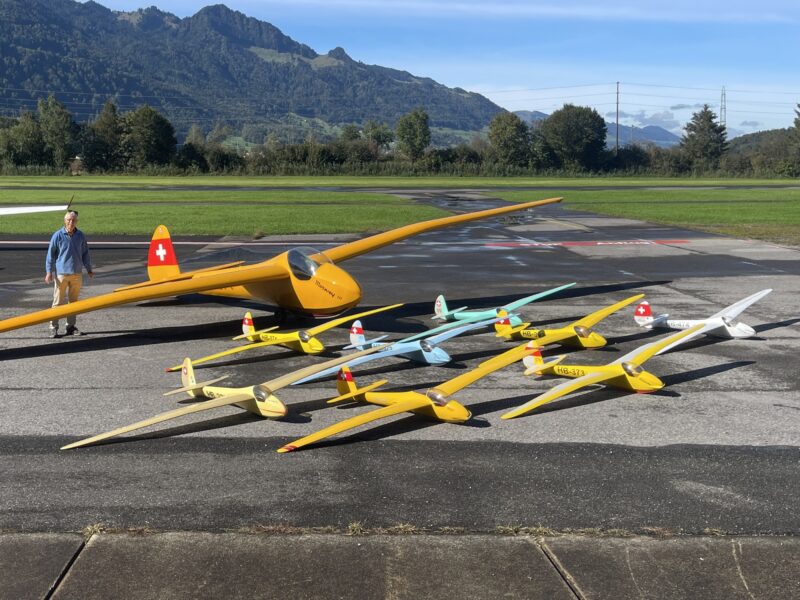
The original 1944 Moswey III HB-374 is owned by the Oldtimerclub Schänis, based at the Schänis Glider Airfield in Switzerland. It’s in excellent condition, airworthy and regularly flown.
Our club had the opportunity to bring together the original 1944 HB-374 Moswey III and our club’s Mosweys for a photo session. The photo session was an event that I was very much looking forward to attending. Unfortunately my attendance was thwarted last minute by a sudden COVID infection, requiring me to stay at home. Club colleagues and friends Georg, Andi, Paul and Willy thankfully made sure that all our club’s Mosweys, including mine, made it to the event and took some great pictures.
Clicking on the picture below brings you to the website of our club with all photos.
My trusty Futaba T18SZ is getting older and has had many hours of flight time – without any issues. As I don’t want to change to another system (Futaba never failed me, I have loads of receivers and I’m too lazy to re-program all my gliders on a new system) I was keen to try out the newly released Futaba T26SZ. As soon as one popped up in the inventory of one of my local model shops yesterday afternoon I rushed out and got it.
This afternoon I had my first flights with the new transmitter. Here are my first impressions.
First the good things:
One of the reasons that I always liked my T18SZ is the low weight. The T26SZ is 5 grammes lighter (922gr), very easy to handle and much lighter than some of the other brands.
The sticks feel great, very similar to what I was used to on the T18SZ. “Potless” sticks have been the rage over the last few years and are now standard on the T26SZ (although I’ve yet to meet anybody who had issues with the sticks on the standard T18SZ).
The operating system of the T26SZ is essentially that of the T18SZ, with a few extra “gimmicks”. That makes it easy to dive straight into. I was particularly pleased that the T26SZ did not build upon that of the T32MZ, which, in my view, is over-engineered and a pain to use. The model picture on the display as well as the possibility to assign sounds to switches are a nice new addition. Many will also appreciate the elaborate sequencing options.
A great plus is the 2nd screen at the top of the transmitter. It’s very easy to read and “always on”, providing the option to show either telemetry data or the timers (I’ve chosen the latter, as my telemetrics come via headphone). Another benefit is the new antenna, which is much less vulnerable and exposed than that on the T18SZ (I’ve seen them broken off on multiple occasions).
Transferring the first few models from my T18SZ to the T26SZ was a breeze, using a micro-SD card with a converter to a standard SD card. When copying the models from the card onto the T26SZ it automatically and instantly converts them to the new transmitter. All that remains is binding the receiver(s) as well as installing telemetry. Easy. I’ve not found any conversion errors so far.
There are a few things that I’m not so satisfied with. Some of them I hope will be addressed in future software updates or as I explore the transmitter’s possibilities:
My main issue is with the sliders at the lower right and left of the T26SZ. As a glider pilot I use the lower left slider for the motor and the lower right glider to switch between different positive camber positions (I usually have three). The new sliders are much smaller, do not have much resistance (move too easily) and do not feel very precise. Whereas that’s simply annoying with the camber positions, it can be dangerous with the motor. Even though I use a safety switch for the motor on the transmitter, it’s (too) easy to touch the slider and engage (or disengage) the motor. Probably much of this just takes getting used to. I do however want to check if there’s a way to give the sliders a bit more resistance. I’ve yet to make up my mind if I like the fact that there are now two sliders on each side rather than the single slider on the T18SZ. On the left side I will probably tape over the outer slider.
A real pain is that the number of models that can be stored on the transmitter itself remains limited to 30 and you cannot operate a model from the SD Card. I had hoped that this number would have been increased. I’m about to hit the 30 limit on my T18SZ and dislike having to copy models from/to the SD Card (yes, I fly all my models, I’ve sold the ones I don’t fly).
Much less important, but still annoying, is the positioning of the micro-SD card. Getting the card it in and out is finnicky. Especially in the beginning I had to move the card it back and forth very often to get the hang of transferring the models and the model pictures onto the T26SZ. Once all my models are converted it should however be fine.
The model pictures option is fun, but requires some work as all pictures need to be exactly 160×80 pixels, in a 24bit BMP file and with maximum 8 characters in the file name. Do one thing wrong and it’s not recognized by the system. No mercy.
Even though there is a whole range of pre-defined sounds, there are some that I would have liked that are missing (camber settings) and all of them are in English only. I’ve not found a possibility to add new or custom sounds.
Can I please rename my telemetry sensors? I mostly use my SM Modellbau GPS Logger 3 and find the “borrowing” of wrong sensor names simply annoying.
The two functions that I missed most when I transferred from my T14SG to my T18SZ have not been brought back: autolock of the screen/menus (after x seconds) and the ability to adjust the telemetry volume through one of the dials on top of the transmitter. While that’s not a disadvantage compared to the T18SZ, it is a missed opportunity for the T26SZ. I spend much of my time on the slope and would like to be able to turn up the volume in strong winds/gusts. The manual is also very explicit about the need to lock the touch-screen, so an autolock really would make sense.
One final point to raise is that I’ve not yet been able to get my SM Modellbau GPS Logger 3 to work on the new transmitter. For some reason it gives weird values for the GPS sensor (multiplied by 256 and a minimum speed of 64kmh). There’s probably an easy fix for this, but I’ve yet to find it. [EDIT 30.9.2024: the new software update v.1.2 for the T26SZ remedies this problem – with many thanks to Arwico and Futaba for correcting this bug so quickly]
All in all my first impression is moderately positive, but I really need to use it more to form a definite opinion. So far, I find the transmitter an interesting evolution compared to the T18SZ, certainly not a revolution, that provides a number of improvements over the T18SZ, but also misses a few obvious chances. I was certainly not looking for a revolution in the new T26SZ, and am happy that it builds so much on the T18SZ. I do hope that the list of issues that I’m not too happy with will be reduced as I get to know the transmitter better and as Futaba comes with the inevitable software updates in the next few months.
I picked up my first 2.8m Swift from Uwe Freitag (Fridayfly) in December 2019. I’ve not flown it very often – usually a few times each year in Hahnenmoos on Lavey – but have had great fun with it. It’s the ultimate slope racer – so fast, and so robust, excellent for heavy duty slope conditions.
As the waiting list for Fridayfly planes is very long I immediately booked a building slot for a new plane when I picked up the 2.8m Swift. In December last year (2023) I got the long-awaited email that my building slot was coming up in June 2024. The really cool thing about Fridayfly is that you can decide on what plane you would like to have built in the months before your building slot comes up – in addition of course to any customisation of the plane. After a friendly call with Uwe I decided to go for the new 3.06m Swift. When I ordered it he had just maidened the new glider and was very pleased with the performance. As for the colour I decided to go for yellow with nice black and white stripes on the underside of the wings. Uwe completely built the plane for me – including installing the motor and all servos. All that was left for me to do was install the ESC, receiver, backup power and battery – and of course program the transmitter. My new Swift is now ready to maiden – watch this space!
I’ve sold my 2.8m Swift to my boss, the President of the Swiss Aeromodelling Federation, who will undoubtedly have loads of fun with it. I’ve also booked a new building slot – the next available was for the end of 2030…..
We’ve now had a few opportunities to fly our Chocofly DG800. We’re still tinkering with the settings, but are close to the final result. It’s a fun plane. With the large wingspan and short fuselage it’s very manoeuvrable and the airfoil allows both for good thermalling and faster flying. Without pushing it too much I got to 235kmh – more should be possible. At the same time it likes a bit of camber and can be thermalled really nice and slow. Here’s a video that I made from our flying yesterday. The air was very gusty and choppy, so not the best conditions for flying, but the DG800 dealt with it very well. Also note that the mix of the rudder and ailerons isn’t optimal yet, the plane should be more stable when we get that right.
Today I dropped my Monnett Monerai off with my mate Andi, who will try to spray paint it over the next few weeks. While waiting for the Monerai to come back from the paintshop and with weather that continues to be really gruesome, it was time for some maintenance work on my glider fleet.
My favourite plane for our local slope (Pfannenstiel – 10 minutes from where I live) is the Chocofly 2.8m Taranis. Its combines speed with stability, loves a bit of ballast and yet is light enough for an easy hand start. Most importantly, it has a tremendous speed spectrum (easy thermalling to really very fast – well over 300kmh – unballasted) and is very uncritical to fly – unlike for instance my Chocofly Kobuz, which is a great glider for heavy slope conditions, but is trickier to fly and doesn’t have the versatility of the Taranis. I was lucky to get one of the first production models of the Taranis when it came out in 2019 and built the prototype with a FES system (6S with our usual Leomotion/Dualsky outrunner). A video of one of the first flight of my Taranis (with information on the setup) can be found here. The flight on the video is without ballast. With a bit of ballast it’s way faster :-).
When I built my Taranis in 2019 the choice of linkage systems for the wing control surfaces was relatively limited and I decided to build my own, using a combination of brass and aluminium. After five years of flying the play on these linkages was too much for my liking. I’d been putting off changing the linkages, but yesterday I decided to upgrade the Taranis to the latest Chocofly Linear Drive System (LDS) – with aluminium servo horns, carbon rudder horns and steel/brass/aluminium connectors. It’s a system that I first built into my Ventus and am very satisfied with – there is zero play on the wing control surfaces and it’s much easier to install than the LDS systems I used earlier.
The hardest part of upgrading the Taranis was removing the old rudder control horns. Fortunately these were made out of aluminium, so I heated them with my soldering rod to melt the epoxy resin glueing them into the control surfaces and prised them out using pliers. After that installing the new carbon rudder control horns wasn’t too hard. The Taranis is now ready for further slope action. Hopefully I get to try out the updated Taranis on our local slope soon.
The Monerai is finally ready to go to the paint shop to be spray painted by my mate and expert painter Andi. Preparing it for the paint shop is always more work than I plan for and way down low on the list of my favourite jobs. It’s also a job that seems endless – every time you finish a coat of primer you see new small bits or holes that can be improved. But I put the limit at two coats of primer and small corrections using a spraycan – it’s a self-built glider made for flying, not a museum piece, and may have some imperfections.
I first lightly sanded and cleaned the glassed wings. Then I applied the first coat of filler. Andi provided a new product from Adler. It’s pretty easy to handle and easy to sand, but stinks like hell. I thus had to wait for a day with decent weather so that I could work in the open and well aired barn – still using a good face mask and gloves. We usually apply the first coat with a filling knife, but this time I used a paintroller. This may well have been a mistake, as I may have more remaining pinholes than usual (we’ll see that after it comes back from the paint shop). After letting the first coat of filler cure for a night (in the warm workshop) I then sanded the wings using my small electric sanding machine (A bosch PSM160A) with 180 grit paper for the larger surfaces. I recently purchased a connector and flexible tube to connect it to my vacuum cleaner and was pleased by how much that reduced the amount of dust (and less pleased by the amount of work to clean the vacuum cleaner afterwards). smaller surfaces I sanded by hand, using 280 grit sanding paper. I repeated the entire process to make sure that all areas were well filled. I also used a spraycan of colormatic filler to make small corrections at the wingtips and on top of the tailplane, also in an effort to remove any remaining pinholes on the upper side of the tailplane and wings.
I also applied filler to the seam of the fuselage and the tail boom. After sanding the tail boom and fuselage I used the same colormatic filler for a second layer on the tailboom and for correcting small holes on the fuselage. I then sanded everything with grit 600 sanding paper (wet) to ensure a smooth surface.
As I already had the tailplane of the Diana4 readily glassed I also prepared this for spray painting. I also hope that Andi will be able to spray the tailplane of my Avanti white. It’s now yellow and a white tailplane would nicely match the white wings.
Fingers crossed now that we’ll be able to get a slot in the paint shop soon.
This spring has not been good for flying so far – the weather has been all over the place. On 8 April I did however finally get a chance to maiden my Chocofly DG800. My mate Georg, who also built one, maidened his two days earlier. Unusually, he struggled a bit to get it flying well and had to play around with the throws, incidence and center of gravity. I greatly benefitted from his experimenting and was able to maiden mine with much improved settings.
We’ve changed the incidence significantly (reduced it to around 1.2 degrees by applying five layers of masking tape under the front of the tailplane) and moved the center of gravity to 68-69mm. It also needs a lot of differential on the ailerons.
With these setting the plane flies very well. It has the perfect combination of light weight (easy hand start), good thermaling and a lovely acceleration, exactly what I was looking for. Unfortunately the wind changed to a northerly breeze early in the afternoon, so we were unable to experiment further. The settings are thus still preliminary and will need to be fine-tuned. More details once I get the chance to fly it again.
My Monerai is still waiting for its coat of primer before heading off to the paintshop. My mate Richi, who’s built the plug and mould for the Monerai fuselage, already finished his Monerai a while ago. He had the maiden flight yesterday.
We were incredibly lucky with excellent conditions on the “airfield” of his club (Modellfluggruppe Wald), which is a wonderful SW-facing slope with stunning views over lake Zürich. Richi first launched a small glider to check for lift – of which there was plenty. I then launched his Monerai for him.
Maiden flights of an all-new self-built model are always a bit of a gamble. While you can calculate the center of Gravity and incidence, as well as throws, our experience is that these values are mostly less useful than following our instinct and experience. Richi’s instinct and experience proved right – as so often. The Monerai flew wonderfully right from the start – in fact his first flight lasted more than two hours! He will need to experiment a bit with the CG and throws still, but the settings are not far off where we’re likely to end up.
I made a video of the first flight, including start and landing. Between filming I also flew my self-built Ventus 2c for an hour and a half. Pure bliss.
My new Chocofly DG800 is now also ready for the maiden flight. Finishing the canopy was quite a bit of work. I wanted to have a “hidden” lock (under the left wing) – as I do with all my larger scale gliders. I also needed to cut out part of the seat pan for the motor. Fortunately the seat pan was a really good fit, as was the canopy, so glueing it together wasn’t too much of a hassle. I wasn’t sure what glue to use – my mate Georg used canopy glue – but decided to go for thickened and whitened epoxy resin. To avoid epoxy getting onto the fuselage I put clingfilm into the fuselage and some grease on the canopy lock and pin at the front. I then applied a thin layer of epoxy resin to the side of the seatpan, installed the seatpan onto the fuselage and then carefully put the canopy on top. With a bit of waxtape I fixed it into position and waited for the epoxy to cure. Instead of painting the canopy edge I used vinyl tape. Chocofly kindly sent me the plotter file for the canopy frame so that I could plot it on my trusted Cameo 3. Applying the sticker required a steady hand but went well. Canopy looks fine.
I also finished installing the electronics in the fuselage and added the decals. My mate Georg’s DG800 is also ready for it’s maiden flight – hopefully we can maiden them together in the next few weeks. More pictures to follow then.
The Monnett Monerai’s airframe is now ready for painting. I installed the landing gear and spray painted the canopy frame. I also made the basic parts for the seat pan and instrument panel.
The next step is applying primer to the wings and parts of the fuselage. That’s something I really dislike – the primer is very smelly and sanding it gives a huge mess. I’ve been waiting for it to get a bit warmer so that I can work in the barn with the door open. I hope to get a chance next week – especially since it’s likely that I may get a slot in the paintshop the week after next. Fingers crossed.
The Chocofly Avanti fuselage is repaired, spray painted, polished and the electronics installed. It’s now ready for the (re-)maiden flight. The yellow paint came out ok – it’s a standard acrylic car paint (spraycan) that’s not too far off the gelcoat yellow of the fuselage. I managed to nicely polish the newly painted part. Unfortunately, as expected, the transition to the “old” paint will always remain visible. I’ll have the upper side of the horizontal stab painted white to match the white wings when the Monerai heads off to the paintshop.
I hope to have the maiden flight in the next few weeks. Interesting will be to also fly my Avantihawk (which uses the same pair of wings) on the same day to see the difference in performance.







You must be logged in to post a comment.